
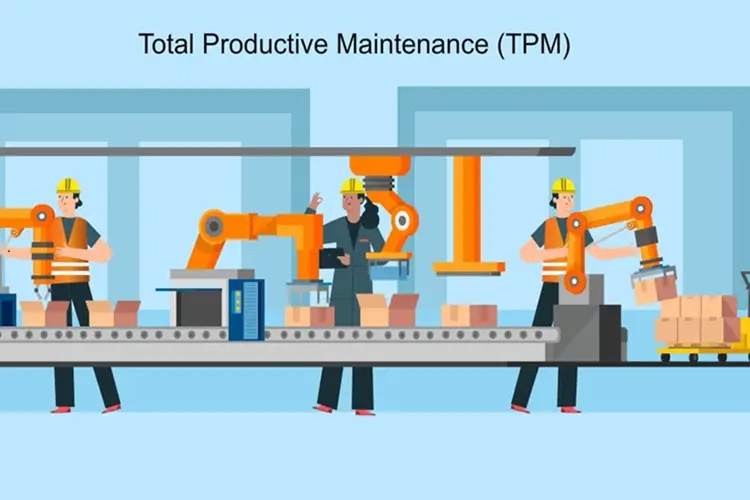
In today’s competitive industrial environment, companies cannot afford frequent breakdowns, quality defects, or production delays. To tackle these challenges, many leading organizations adopt Total Productive Maintenance (TPM), a system that maximizes equipment effectiveness by involving every employee.
TPM is not just a maintenance strategy; it leads to a cultural transformation.
What is Total Productive Maintenance (TPM)?
Total Productive Maintenance (TPM) is a proactive maintenance approach designed to:
- Maximize equipment effectiveness
- Reduce breakdowns and defects
- Involve operators in basic maintenance
- Improve productivity and safety
TPM began in Japan, developed by the Japan Institute of Plant Maintenance (JIPM). It gained global popularity as part of Lean Manufacturing and World-Class Manufacturing practices.
Objectives of TPM
The main goals of TPM are:
- Zero breakdowns
- Zero defects
- Zero accidents
- Zero minor stoppages
- 100% employee involvement
The ultimate aim is to improve Overall Equipment Effectiveness (OEE).
The 8 Pillars of TPM
TPM is built on eight main pillars:
Autonomous Maintenance
Operators are trained to perform basic maintenance such as cleaning, inspection, lubrication, and tightening. This reduces the need for maintenance teams for minor issues.
Autonomous Maintenance
Maintenance tasks are scheduled based on equipment condition and history to prevent unexpected failures.
Focused Improvement (Kaizen)
Small, ongoing improvements eliminate losses and boost efficiency.
Quality Maintenance
This ensures machines produce defect-free products through condition monitoring.
Early Equipment Management
New equipment is designed with maintenance prevention and ease of operation in mind.
Training & Education
This covers continuous skill development for operators and maintenance staff.
Safety, Health & Environment
The goal is to create a safe working environment with zero accidents.
Office TPM
This improves administrative and support processes to cut waste.
The Six Big Losses Addressed by TPM
TPM focuses on removing the Six Big Losses that hurt productivity:
- Equipment breakdowns
- Setup and adjustment losses
- Idling and minor stoppages
- Reduced speed losses
- Process defects
- Startup losses
Eliminating these losses can significantly improve OEE.
Benefits of TPM
Implementing TPM leads to:
- Increased equipment reliability
- Reduced maintenance costs
- Higher production output
- Improved product quality
- Better employee ownership
- Strong safety culture
Why TPM is Important for Pakistani Industries
In Pakistan, many industries still operate reactively, fixing machines only when they fail. This leads to:
- Production delays
- High maintenance costs
- Quality complaints
- Safety risks
TPM changes the mindset from “maintenance is the maintenance department’s job” to “maintenance is everyone’s responsibility.”
For industrial organizations, including manufacturing plants, textile units, food processing factories, and compressed air system users, TPM ensures long-term operational excellence.
Steps to Implement TPM
- Management commitment
- Awareness training for employees
- Formation of TPM committees
- Initial equipment cleaning and inspection
- OEE measurement
- Pilot area implementation
- Company-wide rollout
Implementation usually takes 1 to 3 years, depending on the organization’s size and commitment level.
TPM and Industrial Air Systems
For industries using air compressors and compressed air systems, TPM is especially valuable. Regular inspections of:
- Air compressors
- Filters
- Lubrication systems
- Heat exchangers
- Air leaks
can drastically reduce downtime and energy losses.
Need TPM Training for Your Team?
If you want professional training for your team on Total Productive Maintenance (TPM), we are here to help.
We offer:
- In-house TPM training
- Industry-focused practical approach
- Real case studies and OEE implementation
- Customized content according to your plant needs
Contact us today to arrange a TPM training session for your team and start your journey toward zero breakdowns and maximum productivity.